
Creating and publishing a book sounds easier than it actually is.
You need to find a good topic, research the market, create an outline, write the manuscript, edit the content, design a cover, format the book, prepare metadata, and then publish it. If you also want an audiobook, there is another production process to manage.
This is where ClaudBook OS enters the picture.
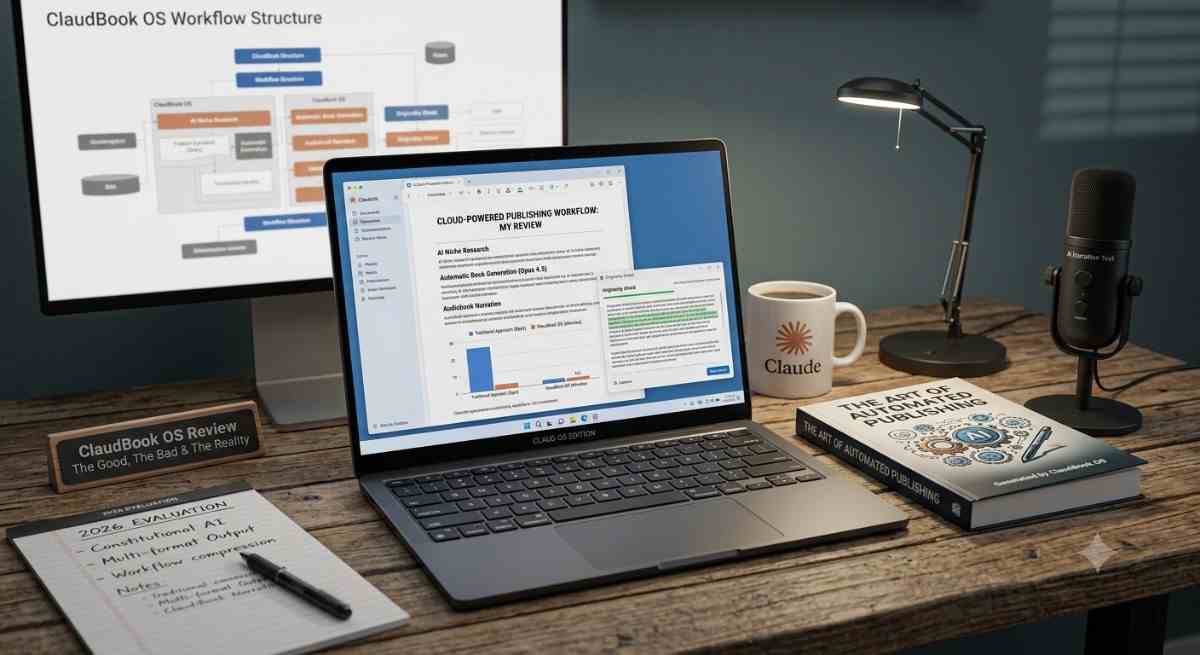
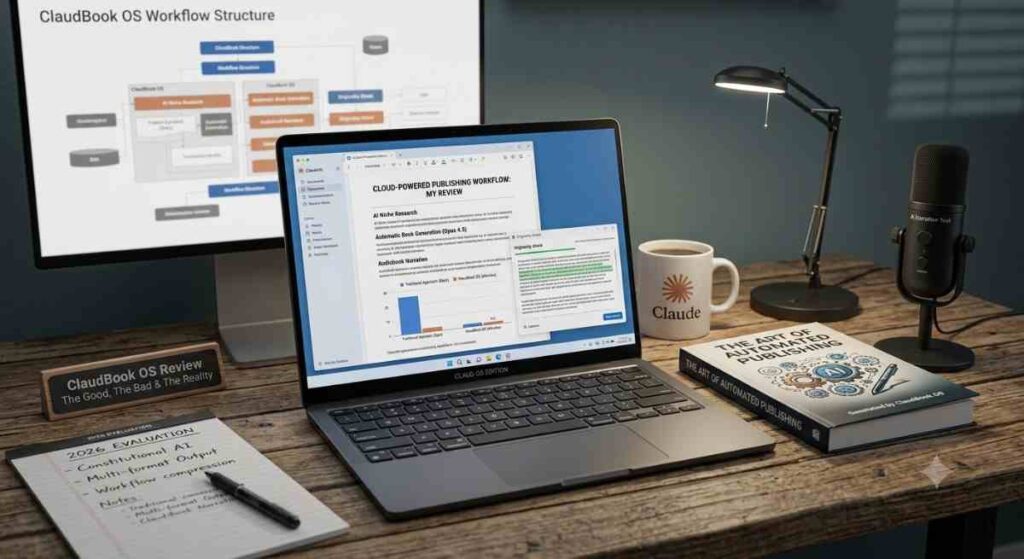
ClaudBook OS is an AI-powered publishing platform designed to bring several parts of the book-creation workflow into one system. According to current product information, it uses Claude-powered AI agents for tasks such as research, writing, cover creation, formatting, audiobook production, optimization, and publishing.
But is ClaudBook OS actually useful, or is it simply another AI product with impressive marketing?
In this ClaudBook OS Review 2026, we’ll look at what the software claims to do, its features, pricing, advantages, disadvantages, potential use cases, and whether it makes sense for beginners and experienced publishers.
ClaudBook OS Review 2026 – Quick Overview
| Product | ClaudBook OS |
|---|---|
| Product Type | AI Publishing Software |
| Main Technology | Claude-powered AI |
| Creator | David Williams et al. |
| Launch | September 5, 2026 |
| Main Purpose | Book creation and publishing |
| Publishing Formats | eBook, paperback, hardcover, audiobook and more |
| KDP Support | Yes, according to product information |
| Audible Support | Yes, according to product information |
| Commercial License | Offered |
| Money-Back Guarantee | 30 days, according to current offer information |
| Front-End Price | Promotional pricing varies |
| Skill Level | Beginners to experienced publishers |
The launch listing currently shows a $17 front-end price, while other review pages report $14.95 or promotional pricing. Because launch pricing can change, buyers should verify the price on the checkout page before purchasing.
What Is ClaudBook OS?
ClaudBook OS is positioned as an AI-powered publishing system that helps users move from a book idea to a finished publishing asset.
Instead of using one application for writing, another for covers, another for formatting, and another for audiobook production, ClaudBook OS attempts to combine these tasks into a centralized workflow.
Current product descriptions mention features for:
- AI-powered niche research
- Book planning and outlining
- Manuscript generation
- Chapter creation
- Cover design
- Audiobook creation
- Voice narration
- Book formatting
- Metadata optimization
- Multiple publishing formats
- KDP and Audible publishing
This is the most important idea behind ClaudBook OS.
It isn’t simply an AI chatbot designed to write paragraphs.
It is marketed as a broader publishing workflow.
That distinction could make it more useful for someone who wants to create multiple books rather than simply generate occasional AI content.
How Does ClaudBook OS Work?
The basic concept is relatively straightforward.
You start with a publishing idea, topic, keyword, or niche.
The system then helps with the different stages required to turn that idea into a book.
Step 1: Research a Book Opportunity
The platform is promoted as having AI-powered niche research capabilities designed to help users identify potential publishing opportunities.
This can be useful because choosing the right topic is often more important than simply writing quickly.
A poorly researched topic can produce a technically good book that nobody wants to buy.
AI research can therefore provide a useful starting point.
However, users should still independently verify market demand, competition, reader expectations, and Amazon policies before publishing.
Step 2: Create the Book
Once the topic is selected, ClaudBook OS can assist with developing the book structure and manuscript.
Product information describes an AI chapter and book-generation workflow designed to produce long-form content.
The advantage is obvious:
Instead of beginning with a blank document, you start with an AI-assisted publishing workflow.
You can then review, edit, improve, and customize the material.
Step 3: Create a Cover
A book needs a cover that matches its genre and audience.
ClaudBook OS includes an AI cover-design feature intended to generate cover concepts for different publishing formats.
This could be particularly useful for beginners who don’t have professional graphic-design skills.
Still, I would recommend reviewing every AI-generated cover carefully.
Typography, imagery, readability, genre conventions, and branding all matter.
Step 4: Format the Book
Formatting can become surprisingly complicated when you publish across multiple platforms.
The product is promoted with an AI Smart Formatter designed for formats including Kindle, paperback, hardcover, and audiobook-related publishing workflows.
The benefit here is convenience.
Instead of manually preparing every version from scratch, the software aims to streamline the conversion process.
Step 5: Create an Audiobook
Audiobooks have become an important publishing format.
ClaudBook OS is marketed with an AI audiobook generator and voice narration capabilities that can turn written content into audio.
For authors who want to repurpose one manuscript into multiple formats, this could be one of the more attractive features.
Step 6: Prepare and Publish
The final stage involves preparing metadata and publishing assets.
Current product information promotes a one-click KDP and Audible publishing workflow.
However, “one-click publishing” shouldn’t be interpreted as meaning that authors can completely ignore platform requirements.
You should still check:
- Book quality
- Copyright
- Metadata
- Categories
- Keywords
- Cover specifications
- Formatting
- AI-content policies
- Publishing platform requirements
AI can accelerate production, but responsibility for the final publication remains with the publisher.
ClaudBook OS Features
Let’s look at some of the main ClaudBook OS features in more detail.
1. Claude-Powered AI Publishing Agents
The central selling point is the use of Claude-powered AI agents to coordinate publishing-related tasks.
The idea is to have AI assist with multiple stages instead of relying on a single chatbot conversation.
2. AI Niche Research
ClaudBook OS is promoted as having tools for identifying potential publishing opportunities.
This can help users brainstorm topics and investigate potential markets before creating a manuscript.
3. AI Book Generator
The platform can assist with generating long-form book content.
This could save considerable time compared with starting every chapter manually.
But speed shouldn’t replace editing.
A generated manuscript should always be reviewed for factual accuracy, repetition, structure, tone, and originality.
4. Chapter Architect
The product includes an AI-assisted chapter development workflow designed to organize individual chapters and maintain a coherent book structure.
This can be particularly useful for nonfiction books where logical organization is important.
5. AI Cover Designer
The cover-generation feature is intended to help users create book covers without requiring separate design software.
For beginners, having cover creation inside the same workflow can reduce the number of tools required.
6. AI Audiobook Generator
Users can repurpose written content into an audiobook format.
This creates an opportunity to turn one manuscript into multiple products.
7. AI Voice Narration
The system is promoted as providing AI-generated narration.
This may eliminate the need to immediately hire a voice actor for every project, although users should carefully evaluate the quality and suitability of the generated narration.
8. Smart Book Formatting
Formatting is another area where automation can save time.
The software is designed to help prepare different versions of a book for publishing.
9. Multi-Format Publishing
One of the stronger ideas behind ClaudBook OS is content repurposing.
A single book can potentially become:
- Kindle eBook
- Paperback
- Hardcover
- EPUB
- Audiobook
Product descriptions specifically promote multi-format publishing capabilities.
10. KDP and Audible Workflow
The product is marketed as providing a one-click publishing workflow for Amazon KDP and Audible.
That could make the platform appealing to people who want to build a larger catalog.
ClaudBook OS Pricing
Pricing is one area where you should pay attention.
Because ClaudBook OS launched in September 2026, promotional pricing appears across different launch and review pages.
One current launch listing reports a $17 front-end price, while another review lists $14.95 and another source reports a promotional range of $14.95–$23.89.
Therefore, I would not treat one third-party price as permanent.
The safest approach is to check the actual checkout page before purchasing.
Is ClaudBook OS a One-Time Payment?
Current promotional material describes the front-end as a one-time purchase and some product pages advertise no monthly fees or API costs.
However, buyers should distinguish between the core product and optional upgrades.
ClaudBook OS OTOs
Like many online software launches, ClaudBook OS has an upsell funnel.
Third-party launch information lists multiple optional upgrades, including higher-tier access, reseller, agency, and white-label options.
The important thing is that you don’t necessarily need every upgrade.
For a beginner, the front-end product may be enough to determine whether the workflow suits your needs.
Additional upgrades make more sense when they solve a specific problem.
For example:
- Higher capacity may matter to heavy users.
- Traffic-related upgrades may matter to marketers.
- Agency features may matter to service providers.
- Reseller features may matter to people building a software business.
- White-label features may matter to businesses wanting their own branded solution.
Don’t purchase every OTO simply because it appears during checkout.
Choose based on your actual publishing goals.
ClaudBook OS Pros
There are several reasons why ClaudBook OS could be attractive.
1. Centralized Workflow
Research, writing, design, formatting, audio, and publishing are brought together into one workflow.
2. Beginner Friendly Concept
The platform is designed to reduce the technical work associated with publishing.
3. Multiple Formats
The ability to create multiple formats from one project can increase the value of each manuscript.
4. Audiobook Support
Audiobook creation gives publishers another potential format for their content.
5. AI Assistance
AI can significantly reduce the amount of repetitive work involved in research and content production.
6. Commercial Opportunities
The product is also marketed with commercial licensing options, which may be useful for freelancers and agencies.
ClaudBook OS Cons
No AI publishing platform is perfect.
There are several things I would consider before buying.
1. AI Content Still Needs Editing
AI-generated content should not simply be published without review.
You may need to fact-check, edit, rewrite, improve transitions, remove repetition, and add your own expertise.
2. Publishing Does Not Guarantee Sales
Creating a book is only one part of building a publishing business.
Sales depend on:
- Topic selection
- Book quality
- Cover
- Pricing
- Keywords
- Marketing
- Reviews
- Audience
- Competition
3. AI Output Can Vary
The quality of AI-generated writing can vary depending on the subject and instructions.
Human review remains important.
4. Optional Upgrades Can Increase Cost
The front-end offer may be inexpensive, but users can encounter multiple optional upgrades.
You should calculate your total budget before buying.
5. Platform Policies Still Matter
Amazon and other publishing platforms have their own requirements.
Using automation does not remove the responsibility to follow those rules.
Who Should Buy ClaudBook OS?
ClaudBook OS could be worth considering if you are:
Beginner Authors
If you’re interested in self-publishing but don’t know where to start, a guided workflow may reduce the learning curve.
Self-Publishers
Existing authors may use the software to speed up repetitive publishing tasks.
Digital Product Creators
Books can become part of a broader digital-product strategy.
Content Marketers
Long-form content can potentially be repurposed into books, guides, and other assets.
Freelancers
People providing publishing services may be interested in commercial or agency-related capabilities.
Publishing Businesses
Anyone trying to build a larger catalog could benefit from workflow automation.
Who Should Probably Skip ClaudBook OS?
I wouldn’t recommend it simply because AI is popular.
You may not need it if:
- You only publish one book occasionally.
- You already have a publishing workflow you like.
- You prefer writing and formatting everything manually.
- You already own separate tools that cover the same features.
- You expect AI to create guaranteed bestseller books automatically.
The software is a productivity tool, not a guaranteed income machine.
ClaudBook OS vs Traditional Book Publishing
Traditional publishing workflows can involve multiple separate tools and professionals.
For example:
Research → Writing → Editing → Cover Design → Formatting → Narration → Publishing
Each step can involve different software or service providers.
ClaudBook OS attempts to consolidate many of these stages.
That doesn’t necessarily make traditional tools obsolete.
Instead, its main advantage is convenience.
If you value having everything in one ecosystem, ClaudBook OS could be attractive.
If you already have professional editors, designers, narrators, and publishing specialists, the value proposition may be different.
Is ClaudBook OS Worth It?
This is probably the most important question in this review.
My answer is: it depends on how you plan to use it.
If you want an all-in-one AI-assisted publishing workflow, ClaudBook OS is an interesting option.
The combination of research, writing, cover creation, formatting, audiobook generation, and publishing assistance is more comprehensive than simply using an AI chatbot for writing.
Current product information confirms that the platform is designed around this broader publishing workflow.
However, I would not buy it with the expectation that it will automatically produce profitable books.
Your results will still depend heavily on your niche, content quality, editing, positioning, marketing, and publishing strategy.
For that reason, I would view ClaudBook OS primarily as a productivity and publishing automation tool.
ClaudBook OS – Final Verdict
After looking at the features, workflow, pricing information, and intended use cases, ClaudBook OS is an interesting AI publishing solution for people who want to streamline the process of creating books and related publishing assets.
Its biggest advantage is not necessarily one individual feature.
It’s the combination.
Research.
Writing.
Cover creation.
Formatting.
Audiobook generation.
Metadata.
Publishing.
Having these capabilities connected inside one workflow could save time compared with constantly switching between different tools.
At the same time, users should have realistic expectations.
ClaudBook OS cannot replace good research, human editing, creativity, marketing, or business strategy.
If you’re willing to review and improve the AI-generated output and understand how self-publishing works, the platform could be a useful addition to your toolkit.
If you’re looking for a button that automatically creates bestselling books and generates passive income, I would stay away.
Final Rating: 8/10
Best for: Self-publishers, digital creators, beginners, freelancers, and people interested in building a larger book catalog.
Main advantage: An integrated AI-assisted publishing workflow.
Main limitation: AI automation still requires human oversight and doesn’t guarantee book sales.
Overall, ClaudBook OS is worth investigating if your goal is to make the book creation and publishing process faster and more organized.
ClaudBook OS Review 2026 – FAQs
What is ClaudBook OS?
ClaudBook OS is an AI-powered publishing platform designed to help users with research, book creation, cover design, formatting, audiobook generation, metadata, and publishing.
Is ClaudBook OS legitimate?
ClaudBook OS appears to be a recently launched commercial software product. Its launch listing identifies David Williams et al. as the vendor and shows a September 5, 2026 launch date.
As with any new software, buyers should review the current sales page, terms, refund policy, and product documentation before purchasing.
How much does ClaudBook OS cost?
Current launch information shows different promotional prices, including $14.95 and $17. The exact price can change during the launch period, so check the checkout page for the current offer.
Does ClaudBook OS create books?
Yes. Product information states that the platform can assist with researching, outlining, generating, formatting, and preparing books for publication.
Can ClaudBook OS create audiobooks?
Yes. Audiobook generation and AI narration are among the advertised capabilities.
Does ClaudBook OS support Amazon KDP?
The product is marketed as including a KDP publishing workflow. Users should still verify Amazon’s current publishing requirements and review every submission before publishing.
Does ClaudBook OS guarantee Amazon royalties?
No.
No software can legitimately guarantee that a book will generate a particular amount of royalties.
Book sales depend on numerous factors, including demand, competition, content quality, pricing, marketing, and audience.
Is ClaudBook OS good for beginners?
It may be useful for beginners because it attempts to combine many publishing tasks into one workflow.
However, beginners should still learn the fundamentals of book publishing rather than relying entirely on automation.
Does ClaudBook OS require writing skills?
The platform is designed to automate or assist with much of the writing process. Nevertheless, basic editing and quality-control skills are valuable because AI-generated content should be reviewed before publication.
Should I buy the ClaudBook OS upgrades?
Not necessarily.
Start by deciding what you actually need. Optional upgrades may be useful for specific users, but buying every upgrade isn’t required simply to explore the core concept.
What is the biggest advantage of ClaudBook OS?
The biggest advantage is the attempt to combine multiple publishing tasks into one AI-assisted workflow rather than requiring users to manage numerous separate applications.
What is the biggest disadvantage?
The biggest limitation is that automation doesn’t eliminate the need for human judgment.
You still need to choose good topics, review content, check facts, improve the manuscript, follow publishing policies, and market your books.